
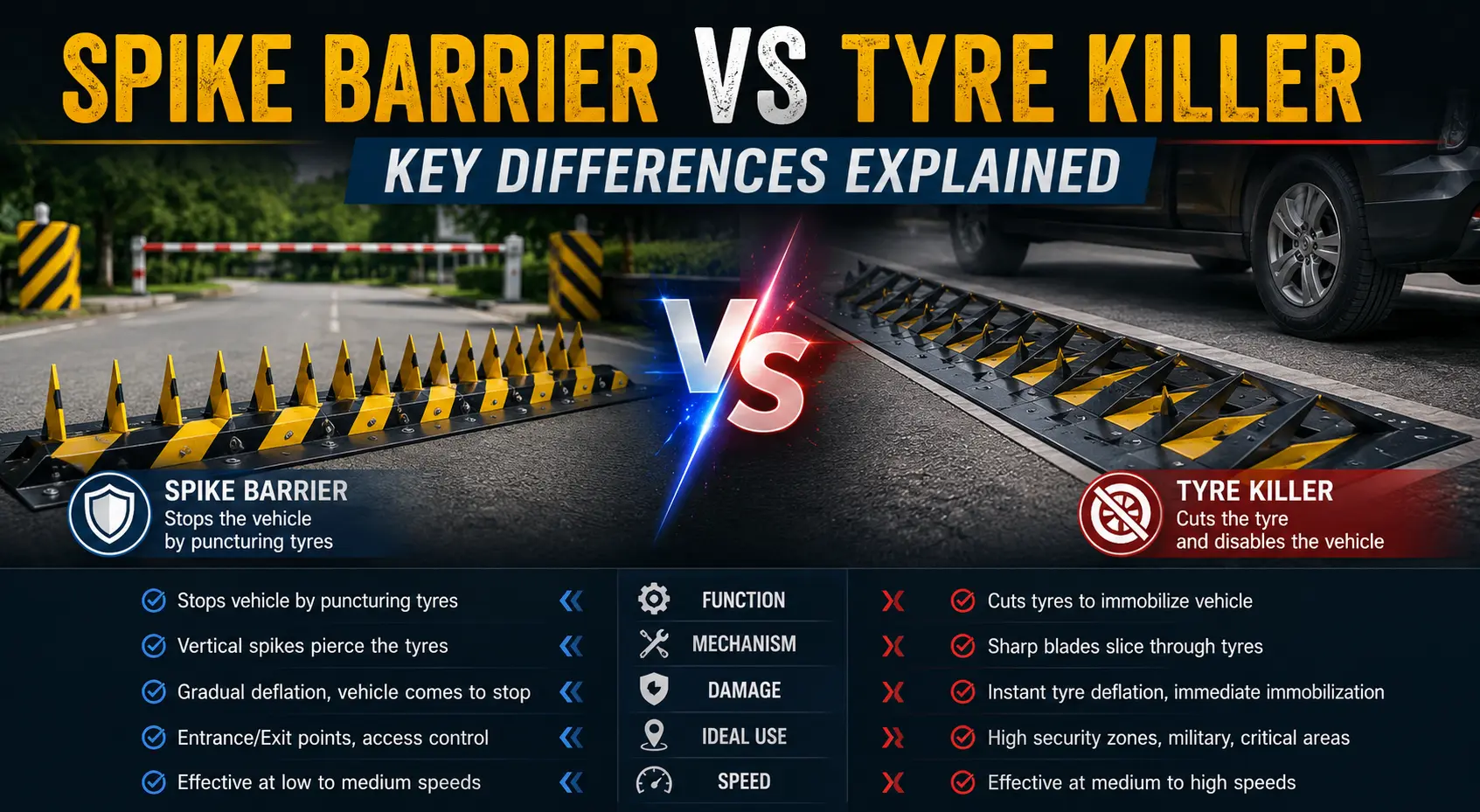
When it comes to controlling vehicle access and securing sensitive premises, two products consistently appear at the top of the shortlist: the spike barrier and the tyre killer. Both are proven perimeter security tools, yet they serve distinct purposes and suit different threat environments. Choosing the wrong one can mean gaps in your access control strategy — or unnecessary costs.
In this guide, our security specialists at eTradeFia break down the key differences between spike barriers and tyre killers — covering their mechanisms, applications, installation requirements, and cost implications — so you can make a confident, well-informed decision for your facility.
What Is a Spike Barrier?
A spike barrier — also referred to as a traffic spike strip or road spike — is a surface-mounted or embedded security device fitted with sharp, angled metal spikes. These spikes are engineered to puncture the tyres of any vehicle that attempts to pass in the wrong direction, while allowing authorised vehicles to pass safely in the designated direction.
The directional design is the defining feature. Spikes lie flat when a vehicle drives over them in the approved direction, but rise aggressively if a vehicle moves in reverse or attempts an unauthorised entry. This makes spike barriers particularly effective at controlling one-way traffic flows in medium-security environments.
Where Are Spike Barriers Commonly Installed?
- Commercial and residential parking lots
- Petrol station forecourts and drive-throughs
- Toll plazas and border control checkpoints
- Hotel and resort entry/exit lanes
- Car rental and fleet management facilities
Explore our anti-spike barrier range and find the right surface-mount solution for your property at eTradeFia.
What Is a Tyre Killer?
A tyre killer, sometimes called an anti-vehicle spike system or hostile vehicle mitigation (HVM) device, is a flush-mounted security barrier that deploys a set of hardened metal teeth from the road surface. Unlike spike barriers, tyre killers are typically automated and can be raised or lowered on command or via vehicle detection sensors.
They are designed for high-security environments where unauthorised vehicle access poses a significant risk. When a vehicle ignores access protocols and attempts to drive through without authorisation, the tyre killer rises and causes immediate, severe tyre damage — effectively immobilising the vehicle.
Where Are Tyre Killers Typically Deployed?
- International airports and aviation facilities
- Military bases and government installations
- Prison perimeters and detention facilities
- Embassies and high-security diplomatic zones
- Power plants and critical national infrastructure
Spike Barrier vs Tyre Killer: Side-by-Side Comparison
The table below provides a structured comparison of the two systems across the most critical evaluation criteria for security managers and procurement teams:
| Feature | Spike Barrier | Tyre Killer |
| Primary Function | Prevents unauthorized entry | Destroys tyres on reverse |
| Traffic Direction | Allows one-way flow | Strictly one-way enforcement |
| Threat Level Suited | Medium-security zones | High-security perimeters |
| Vehicle Damage Risk | Low (when used correctly) | High (on reverse attempt) |
| Surface Installation | Embedded or surface-mount | Flush surface-mount |
| Common Use Cases | Parking lots, toll plazas | Airports, military, prisons |
| Maintenance Needs | Moderate | Low to moderate |
| Cost Range | Moderate | Moderate to high |
5 Key Differences That Really Matter
1. Security Level and Threat Environment
Spike barriers are well-suited to medium-security settings where the primary goal is managing traffic flow and deterring casual misuse. Tyre killers, by contrast, are engineered for high-threat environments where forced vehicle entry is a genuine, active risk. If your site handles classified assets, detainees, or large crowds, a tyre killer provides a far more robust last line of defence.
2. Automation and Operational Control
Most spike barriers function passively — they are always present and work through their directional spike design without operator input. Tyre killers, on the other hand, are frequently integrated into automated access control systems. Security personnel can raise or lower them remotely, link them to ANPR cameras, or synchronise them with boom gates and road blockers for a layered perimeter security approach.
3. Installation Complexity and Site Disruption
Spike barriers are generally simpler to install. Surface-mounted models require minimal groundwork and can often be fitted within a day. Tyre killers typically require civil engineering work — a recessed pit in the road surface, electrical connections for motor-driven mechanisms, and proper waterproofing. While the upfront effort is greater, the result is a near-invisible system that does not disrupt the aesthetics of prestige or sensitive locations.
4. Maintenance and Long-Term Durability
Spike barriers, particularly those in high-traffic areas, can experience wear on the spike tips and hinges over time and benefit from periodic inspection. Tyre killers, given their mechanical and often hydraulic components, require routine servicing of motors, seals, and sensor systems. However, their below-ground installation protects many components from weather and vehicle impact, offering excellent long-term durability when properly maintained.
5. Cost and Total Investment
Spike barriers are the more cost-effective upfront choice. A quality surface-mounted unit is available at a fraction of the cost of a fully automated tyre killer. However, for environments where security failure carries extreme consequences — financial, reputational, or legal — the investment in a tyre killer system delivers exceptional value. It is important to factor in installation, integration, and maintenance costs when comparing the total cost of ownership.
Which One Is Right for Your Site?
The decision ultimately comes down to your security risk profile, budget, and operational requirements. Here is a practical decision framework:
- Choose a spike barrier if you need reliable, low-maintenance, one-way traffic control for commercial or semi-public environments.
- Choose a tyre killer if your site falls under critical infrastructure, houses vulnerable populations, or requires active, operator-controlled deterrence against hostile vehicles.
- Consider both working together where you need layered protection — spike barriers at entry lanes and tyre killers at the innermost security checkpoint.
At eTradeFia, we work with security consultants, facility managers, and government procurement teams to identify the right product combination for every site profile. Our team can assist with site surveys, compliance assessments, and product specification.
Get a free security consultation with eTradeFia experts — contact our perimeter security team today.
Why Trust eTradeFia on Perimeter Security?
eTradeFia is a specialist supplier of physical security and vehicle access control products, serving clients across commercial, government, and critical infrastructure sectors. Our product knowledge is built on direct supplier partnerships, real-world installation data, and ongoing engagement with certified security consultants. Every recommendation we make is grounded in practical experience — not guesswork.
- Products sourced from certified, tested manufacturers
- Guidance aligned with international security standards
- Dedicated after-sales support for maintenance and integration
- Transparent pricing with no hidden costs
Final Thoughts
Both spike barriers and tyre killers are valuable components of a well-designed perimeter security system, but they are not interchangeable. A spike barrier excels at managing traffic flow and deterring low-level threats with minimal disruption. A tyre killer is the right tool when the stakes are high and passive deterrence is not enough.
Understanding these distinctions allows security managers to build smarter, more cost-effective protection strategies. If you are evaluating perimeter security products, our team at eTradeFia is ready to help you find the solution that fits your site, your budget, and your risk environment.
Ready to secure your perimeter? Browse our full range of spike barriers, tyre killers, road blockers, and vehicle access control products on eTradeFia — or speak directly with one of our security specialists today.
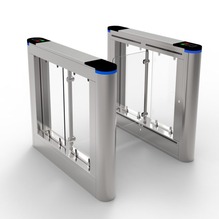 FLIP SW10
 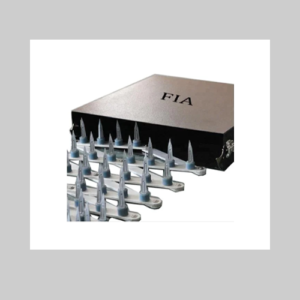 Spike Barrier 400P
 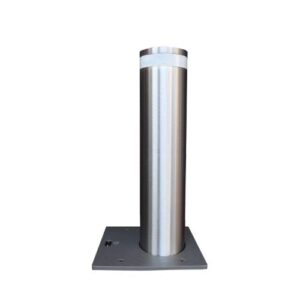 Automatic Hydraulic Bollard 168