What Is a Spike Barrier?
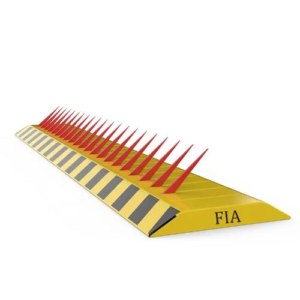
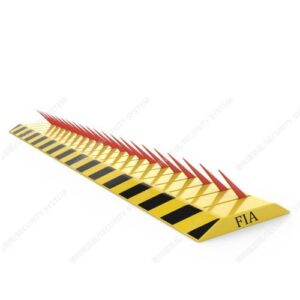
A spike barrier is a vehicle access control device consisting of a series of sharp, hardened spikes mounted on a plate or track. When raised, the spikes puncture tyres on any vehicle attempting unauthorized entry or exit. When lowered or retracted, authorised vehicles pass freely.
These systems are designed primarily as a deterrent and, in controlled environments, as an enforcement mechanism. They are widely deployed at:
- Military and government checkpoints
- Airport perimeters and cargo zones
- Bank and financial institution entrances
- Toll plazas and parking management points
- Corporate campuses and industrial facilities
The core function is straightforward: allow movement in one direction or only for authorised vehicles, and stop unauthorized passage before it happens.
Types of Spike Barriers
Understanding the distinct categories helps facility managers and security consultants match the right solution to each use case.
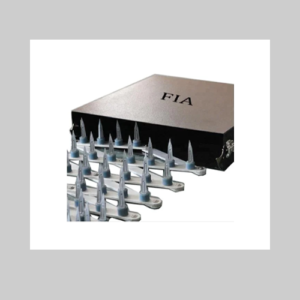
Automatic Spike Barrier
An automatic spike barrier integrates motorized actuation with access control systems — such as RFID card readers, remote control panels, vehicle loop detectors, or biometric devices. The spikes raise and lower without manual intervention.
These units offer several operational advantages. Response time is fast, typically under three seconds for a full cycle. Integration with CCTV, intercom, and barrier management software makes them suitable for unmanned or remotely monitored points. Automatic systems reduce human error and eliminate the staffing cost of manual operation.
For high-traffic entry points, automatic spike barriers are often paired with boom gates or bollards to create layered access control — one system checks credentials, the other enforces the decision.
Modern automatic units are built to withstand thousands of daily cycles and are rated for vehicle weights ranging from standard passenger cars up to heavy goods vehicles exceeding 7.5 tonnes. Stainless steel construction and weather-sealed electronics ensure reliable operation in outdoor environments across varying climates.
Portable Spike Barrier
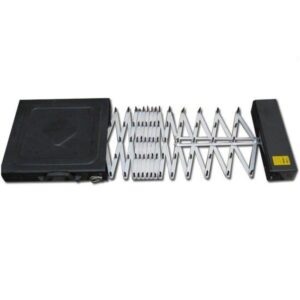
A portable spike barrier provides temporary, deployable access control without the need for civil works or permanent installation. These units are used by law enforcement agencies, military forces, event security teams, and emergency responders.
The design typically features a folding or strip format that can be laid across a roadway rapidly and removed just as quickly. Some portable units are designed as spike strips that deflate tyres on contact, used specifically in vehicle pursuit scenarios.
For civilian event management, portable spike barriers are often used at festival perimeters, construction site entry points, VIP arrival zones, and temporary checkpoints. They offer immediate deployment with no ground excavation, no electrical connection, and no civil permits.
Key selection criteria for portable units include the weight of the unit itself (for ease of deployment), the spike height and angle, and whether the system allows one-way through-traffic or is designed to stop all movement.
Road Spike Barrier
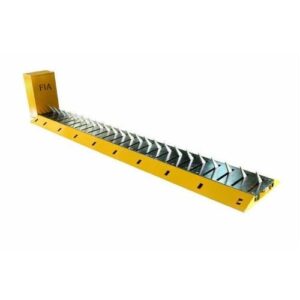
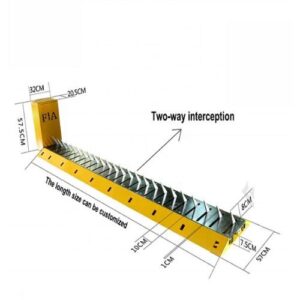
A road spike barrier is permanently recessed into the road surface and flush with the ground when in the lowered position. When raised, the spikes present a physical obstruction across the full width of the lane.
These systems are engineered specifically for integration with existing road infrastructure. The flush, low-profile design means they create zero obstruction for authorised traffic and pose no trip hazard to pedestrians. When deactivated, drivers experience the transition over them with no discomfort.
Road spike barriers are commonly installed at the entrance lanes of secure facilities where continuous vehicle flow is required but controlled access is mandatory. Because they sit in a ground-level housing, the installation requires civil groundwork — a concrete pit, conduit for cabling, and a drainage provision to prevent waterlogging.
Hydraulic and electromechanical road spike barriers are available depending on speed of operation requirements and power availability. Hydraulic systems are typically faster and better suited to high-security environments; electromechanical variants are easier to maintain in locations where hydraulic fluid servicing is less practical.
Tyre Killer
A tyre killer operates on the same principle as a spike barrier but is specifically engineered to cause immediate and complete tyre deflation on contact. The spike profile, angle, and density are optimized to puncture even reinforced run-flat tyres under certain conditions.
Tyre killers are considered a high-consequence security product and are deployed in environments where a determined threat — such as a forced vehicle intrusion — must be stopped decisively. Embassies, prisons, nuclear facilities, and critical infrastructure sites represent the typical application profile.
Some tyre killer systems include a secondary antiretraction feature: once a vehicle passes over the raised spikes in the wrong direction, the spikes lock in position to prevent backing out, trapping the vehicle in place. This is particularly useful at manned checkpoints where security personnel need time to respond.
It is important to note that tyre killers are distinct from standard spike barriers in their operational intent. Standard spike barriers deter and control. Tyre killers are designed to stop and immobilise. This distinction matters both for product selection and for site risk assessment compliance.
How to Choose the Right Spike Barrier System
Selecting a spike barrier involves several practical considerations beyond the type of unit.
Threat level and risk assessment. A corporate car park has different requirements from a military base. Low-threat environments may need nothing more than a basic automatic spike barrier at one lane. High-threat perimeters may require multiple tyre killer installations with anti-ram reinforcement.
Traffic volume and cycle frequency. High-volume sites with hundreds of daily vehicle movements need systems rated for continuous duty cycles. Cheaper units designed for low-traffic sites will fail prematurely under sustained use.
Power supply and redundancy. Automatic and road spike systems require reliable power. Battery backup or UPS integration is advisable to ensure operation during outages. Some hydraulic systems can be manually operated as a failsafe.
Integration requirements. If the spike barrier needs to communicate with a broader access control platform — barrier management software, ANPR cameras, parking systems — confirm compatibility before specifying a product.
Installation environment. Outdoor units must meet appropriate IP ratings for dust and water ingress. Coastal or industrial sites may require additional corrosion protection on metal components.
Compliance and certification. In many markets, perimeter security products used at critical sites must meet recognized testing standards. Verify that the product holds relevant certifications before purchasing.
Installation and Maintenance
Spike barrier systems are not complex to operate, but correct installation is critical to both performance and longevity. Road spike barriers and permanent automatic units require professional civil and electrical installation. Surface-mounted or portable units are more straightforward but still benefit from a trained technician confirming correct alignment and trigger calibration.
Routine maintenance typically involves inspection of spike condition and movement, lubrication of mechanical components, cleaning of sensor loops and detectors, and verification of control panel functionality. Manufacturers generally recommend a scheduled maintenance interval of every three to six months for high-use installations.
Neglected maintenance is the most common cause of spike barrier failure. A system that fails to raise when required is a security breach; one that fails to lower is an operational disruption. Both carry real cost.
Why Etradefia for Spike Barriers?
Etradefia supplies a curated range of spike barriers — automatic systems, portable units, road-integrated products, and tyre killers — selected for build quality, reliability, and value across a variety of security environments.
Whether you are specifying a single-lane access point or planning a multi-perimeter installation, our team can advise on the most appropriate product, integration options, and compliance requirements. Explore the range below or contact us for a site-specific recommendation.
Spike barriers are specialist security products. Always engage a qualified security consultant for site assessment before specifying or installing access control systems at high-risk locations.

 HHMD 200