How Does It Work?
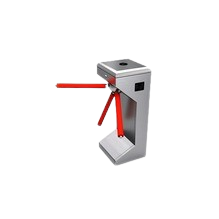
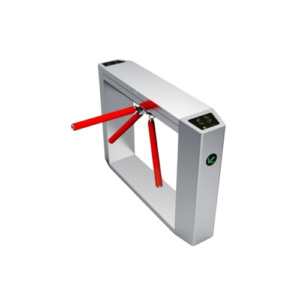
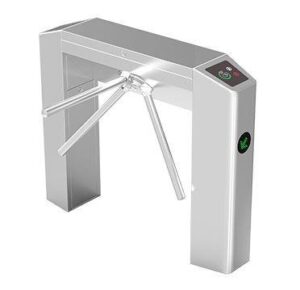
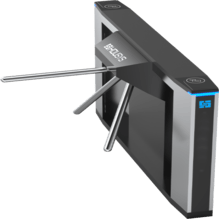
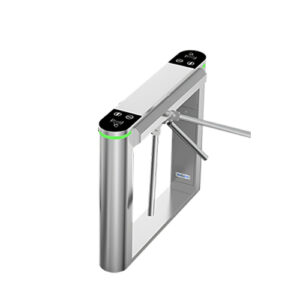
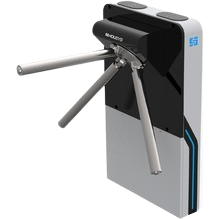
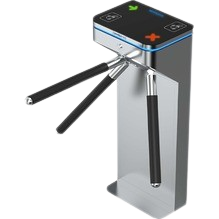
The mechanism is straightforward. The three rotating arms of the turnstile are positioned horizontally, blocking passage in both directions by default. When a valid credential is presented — whether an access card, biometric input, coin, or ticket — the system releases the arm, allowing it to rotate 120 degrees and permitting one individual to pass. After passage, the arm locks again automatically.
This simple but effective design is what makes the automatic tripod so popular. It requires minimal maintenance, handles high footfall efficiently, and integrates smoothly with a wide range of access control technologies.
Where Is a Tripod Turnstile Used?
The applications of a tripod turnstile span virtually every sector where controlled pedestrian entry is needed:
Corporate Offices and IT Parks — Businesses deploy turnstile gates at lobby entrances to ensure that only employees and registered visitors can access the premises. Combined with an employee ID card or biometric reader, it creates a reliable first layer of workplace security.
Manufacturing and Industrial Plants — On factory floors where shift-based entry is critical, a tripod access control system ensures that only authorized workers enter specific zones. It also supports attendance tracking, making payroll management more accurate.
Educational Institutions — Schools, colleges, and universities use tripod access control to manage student entry and exit, particularly during examination periods or restricted-access events.
Stadiums and Event Venues — Ticket validation at large public events is one of the most demanding access scenarios. A turnstile machine at venue entrances handles thousands of entrants efficiently, preventing ticket fraud and queue mismanagement.
Metro Stations and Public Transport Hubs — Fare-gated entry at transit stations is perhaps the most visible use of tripod turnstiles globally. These systems process millions of commuters daily with remarkable reliability.
Gyms and Recreation Centers — Membership-based facilities use tripod access to ensure only paying members enter, removing the need for a receptionist to verify every visitor.
Warehouses and Logistics Centers — Controlled entry into storage and dispatch areas protects inventory and ensures accountability for everyone entering high-value zones.
Turnstile Access Control – Integration and Intelligence
A modern tripod turnstile is far more than just a rotating arm. It is a fully integrated component of a larger turnstile access control ecosystem. Depending on the facility's requirements, it can be paired with:
RFID and Smart Card Readers — The most common integration, allowing employees or members to simply tap their card to gain entry. Fast, contactless, and easy to manage.
Biometric Scanners — Fingerprint or face recognition modules can be mounted directly on the tripod gate, enabling identity-verified access without physical cards.
QR Code and Barcode Scanners — Ideal for event venues and visitor management systems where single-use passes are issued digitally.
Time and Attendance Software — The tripod access control system can feed real-time entry and exit data into HR software, enabling automated attendance reports and reducing manual tracking.
Visitor Management Systems — When integrated with front desk software, the turnstile gate can be pre-authorized for specific visitors during defined time windows, improving both security and hospitality.
This level of integration transforms a simple mechanical barrier into a smart access node — one that generates data, enforces policies, and supports compliance reporting.
Types of Tripod Turnstiles
Not all facilities have the same requirements, which is why tripod turnstiles are available in multiple variants:
Standard Waist-High Tripod Turnstile — The most commonly used model, suitable for indoor environments with moderate footfall. Compact, reliable, and easy to install.
Outdoor Tripod Turnstile — Designed with weather-resistant enclosures (typically stainless steel with IP54 or higher rating), these are built for outdoor deployment at construction sites, open-air venues, or building perimeters.
Bi-Directional Tripod Gate — Allows controlled passage in both directions, making it ideal for locations that need to manage both entry and exit flow simultaneously.
High-Speed Tripod Turnstile — Engineered for environments with very high footfall, offering faster arm rotation and reduced wait times per user.
Coin-Operated Turnstile Machine — Used in public facilities, amusement parks, and transportation hubs where fare collection is handled mechanically without any digital backend.
Key Features to Evaluate Before Purchasing
Choosing the right tripod turnstile for your facility requires attention to several technical and operational factors:
Build Material — Stainless steel (304 or 316 grade) is the preferred choice for durability and resistance to corrosion, especially in humid or outdoor environments.
Rotation Speed and Mechanism — Evaluate how quickly the arm resets after each passage. In high-traffic scenarios, even a one-second difference per person can significantly impact queue formation.
Fail-Safe Mode — In case of a power failure, the turnstile should either lock completely (fail-secure) or open freely (fail-safe), depending on your emergency evacuation requirements.
Noise Level — For office environments and libraries, low-noise motor mechanisms ensure the turnstile does not disrupt the surroundings.
Tamper Resistance — Anti-tailgating features, such as sensors that detect if two people attempt to pass on one authorization, are essential for high-security deployments.
Warranty and After-Sales Support — Given that a turnstile machine operates continuously, access to spare parts and responsive service is just as important as the initial product quality.
Why the Tripod Turnstile Remains a Top Choice
In a market now filled with flap barriers, full-height turnstiles, and speed gates, the tripod turnstile continues to hold its ground — and for good reason.
It offers the best balance of cost, reliability, and functionality for the majority of access control scenarios. Its compact footprint means it fits into tight lobbies and narrow corridors where larger systems simply cannot. Its mechanical simplicity translates to lower maintenance costs and longer operational life.
For facilities that are scaling their security infrastructure without overextending their budget, tripod access remains the most practical starting point — one that can grow with the organization by integrating new technologies over time.
Explore Our Tripod Turnstile Range
Our collection includes indoor and outdoor models, bi-directional configurations, and systems pre-integrated with RFID, biometric, and QR code readers. Whether you are securing a small office or a large industrial campus, we have a tripod turnstile solution designed for your environment.
All systems are backed by installation guidance, technical support, and manufacturer warranty.