
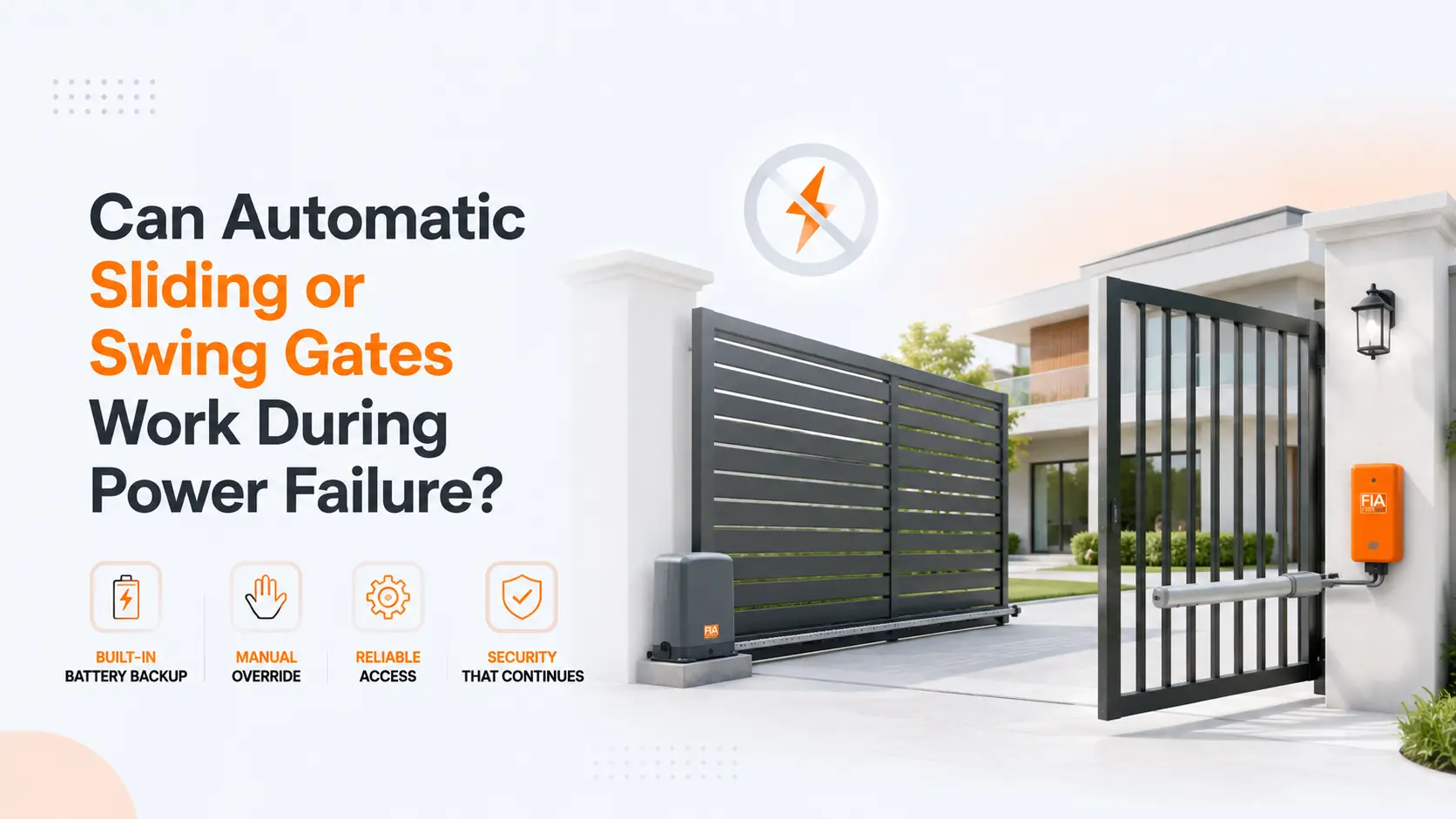
Introduction: A Common Concern for Gate Owners
You’ve invested in an automatic sliding gate to enhance security, convenience, and curb appeal. Then, suddenly, the power goes out — and your gate won’t budge. It’s a frustrating scenario that raises a legitimate question: can automatic sliding gates work during a power failure?
The same concern applies equally to swing gate operators, which are widely used across residential driveways, commercial entrances, and industrial sites. Whether your property uses a sliding or swing configuration, power failure preparedness is one of the most important — and most overlooked — aspects of gate ownership.
The short answer is yes — both gate types can work during a power failure, but only if the right systems are in place. The longer answer involves understanding how gate automation technology handles power interruptions, what backup options exist, and how to choose a setup that never leaves you stranded.
This guide covers everything you need to know, from how modern gate operators respond to outages, to the best backup solutions available today.
How Automatic Sliding Gates Respond to Power Loss
Automatic sliding gates rely on an electric motor — typically a DC or AC motor housed within the gate operator — to drive movement along a track. When mains power is cut, the motor stops, and in most basic setups, the gate either locks in place or becomes difficult to move manually.
However, the gate’s behavior during a power failure depends heavily on the type of operator installed and the fail-safe configuration chosen during setup.
There are generally two default behaviors:
Fail-Secure (Locked): The gate remains locked in its current position when power is lost. This is common in high-security environments where keeping the gate closed — even during an outage — is the priority.
Fail-Safe (Unlocked/Free-Moving): The gate releases its locking mechanism so it can be pushed open manually. This is preferred in residential settings where occupants need to enter or exit regardless of power status.
Understanding which mode your gate uses is the first step to planning for power outage scenarios.
How a Swing Gate Operator Handles Power Failure
A swing gate operator works on a fundamentally different mechanical principle than a sliding gate — but faces the same power failure vulnerabilities, and in some ways is more complex to manage.
Swing gate operators use either a linear actuator (a push-rod mechanism) or an underground hydraulic or electromechanical motor to open one or two gate leaves by pivoting them on hinges. When power is lost, the behaviour depends on the operator type:
Linear Actuator Operators: These are the most common for residential swing gates. On power loss, most linear actuators lock in position by default. The gate cannot be pushed open without engaging the manual release, as the actuator arm physically blocks movement.
Hydraulic Swing Operators: Hydraulic systems are typically self-locking and will hold the gate firmly in whatever position it was in when power failed. These are widely used in heavier, higher-security swing gate installations. A manual hydraulic release valve is the standard emergency override.
Underground Swing Operators: These buried motor units are popular for their discreet aesthetics. Their manual release mechanisms vary by brand but typically involve a release key inserted into a ground-level housing.
Key Difference: Swing vs. Sliding Gates During Outages
One important distinction: sliding gates on a counterbalanced or flat track can often be pushed open relatively easily once the motor is disengaged. Swing gates, particularly heavier ornamental iron or timber leaf gates, can be significantly harder to move manually due to their weight and pivot mechanics. This makes battery backup even more critical for swing gate operators than for sliding systems.
If your property uses swing gates, explore eTradefia’s range of swing gate operators to find models with integrated backup power compatibility.
Manual Override: The Built-In Safety Net
Almost every reputable automatic sliding gate operator includes a manual release mechanism — a physical override that disconnects the motor and allows the gate to be moved by hand.
This is not optional; in many regions, it is a safety requirement under local building or electrical codes.
How the Manual Release Works
- The operator is accessed via a lockable release key or lever, usually located on the motor housing.
- Turning or pulling the release disengages the drive from the gate.
- The gate can then be rolled open or closed manually.
- Once power is restored, re-engaging the motor is as simple as reversing the release step.
This solution works well for most situations but does require physical access to the gate and a basic understanding of the mechanism. If you manage a property remotely or have elderly or mobility-limited residents, a manual override alone may not be sufficient.
Battery Backup Systems: The Most Practical Solution
For properties where uninterrupted operation is essential, a battery backup system is the gold standard. Modern gate automation manufacturers — including brands commonly available through suppliers like eTradefia — offer integrated or add-on battery backup units that keep the gate fully operational during power outages.
How Battery Backup Works
Battery backup units connect directly to the gate operator’s power supply. When mains power is detected as lost, the system automatically switches to battery power — usually within milliseconds, so gate operation is seamless.
These systems typically use:
- Sealed Lead-Acid (SLA) batteries — affordable, reliable, and widely used in automation systems
- Lithium-Ion batteries — lighter, longer lifespan, and capable of more charge cycles; increasingly preferred in modern installations
What to Expect From Battery Backup
A well-sized battery backup can typically power an automatic sliding gate through 50 to 200 full open/close cycles on a single charge, depending on gate weight, battery capacity, and motor efficiency. For most residential properties, this provides more than enough coverage for standard outages.
Key features to look for:
- Automatic switchover — no manual intervention needed
- Low-battery indicator — alerts you before charge is depleted
- Solar compatibility — some units can be trickle-charged via solar panels for off-grid or remote locations
- Charge monitoring via app — smart systems allow you to monitor battery health remotely
Solar-Powered Gate Systems: Off-Grid Independence
For properties in rural areas, or where mains power connectivity is unreliable or costly to install, solar-powered gate automation is an increasingly viable and cost-effective solution.
A solar gate system uses photovoltaic panels to charge a battery bank that powers the gate operator continuously. During daylight hours, the panels replenish the battery, and the stored energy covers operation at night or during overcast periods.
Benefits of Solar Gate Automation
- Completely independent of the electrical grid
- Zero ongoing electricity cost for gate operation
- Environmentally sustainable
- Highly suitable for agricultural, rural, and remote installations
- Works even during extended mains power outages
Considerations
Solar systems require adequate sunlight exposure for the panels and an appropriately sized battery for your gate’s daily usage pattern. A gate that opens and closes dozens of times per day will need a larger panel and battery combination than one used only a few times.
UPS (Uninterruptible Power Supply) for Gate Automation
Another option gaining popularity is integrating a UPS unit — the same technology used to protect computers and servers — into a gate automation system.
A UPS sits between the mains power supply and the gate operator. It maintains a continuously charged internal battery that kicks in the instant power is interrupted, providing seamless, uninterrupted operation.
Unlike dedicated gate backup systems, a UPS also provides surge protection, which can be valuable in areas prone to voltage spikes and unstable power supply — a common issue in many parts of the world.
A UPS is particularly well-suited for:
- High-traffic commercial or industrial gates
- Properties in areas with frequent but brief power interruptions
- Installations where a completely seamless experience is required
Smart Gate Systems and Remote Management During Outages
Modern smart gate controllers go beyond simple backup power — they can actively notify you about power status and allow remote management.
Advanced gate automation systems now offer:
- Push notifications when mains power is lost or restored
- Remote open/close commands via smartphone app (when the gate operator has its own cellular or Wi-Fi connectivity, independent of local power)
- Event logs that record all gate activity, including any outage-related events
- Geofencing — so your gate opens automatically as you approach, with no button press required
When combined with a battery backup, a smart gate system ensures you always know what’s happening with your gate, even if you’re hundreds of miles away.
Common Mistakes That Leave Gates Vulnerable During Power Failure
Many gate owners only discover their vulnerability when an outage actually occurs. Here are the most frequent oversights to avoid:
Not testing the manual release. Install it, know where it is, and physically practice using it — before you need it under pressure.
Undersizing the battery backup. A backup battery that was the right size five years ago may no longer hold sufficient charge. Battery capacity degrades over time; plan for periodic replacement.
Neglecting battery maintenance. SLA batteries benefit from regular charge cycling and should be replaced every 2–4 years depending on usage and conditions.
No surge protection. Power outages are often accompanied by voltage fluctuations when power is restored. A surge can damage an unprotected gate operator. Always include a surge protector or UPS.
Forgetting the access control system. Even if the gate motor has backup power, keypads, intercoms, and card readers also need power. Ensure your entire access control ecosystem is covered.
Choosing the Right Backup Solution for Your Gate
The ideal power-failure solution depends on several factors specific to your installation:
| Situation | Recommended Solution |
|---|---|
| Budget-conscious residential sliding gate | Manual release + basic SLA battery backup |
| Residential swing gate operator | Battery backup (essential — heavy leaves are hard to move manually) |
| High-traffic residential or commercial gate | UPS or dedicated battery backup with monitoring |
| Rural or off-grid property | Solar-powered gate system with battery storage |
| Remote-managed property | Smart gate system with cellular backup and app alerts |
| High-security commercial site | Fail-secure operator + generator integration + UPS |
When sourcing gate automation components and backup systems, working with a specialist supplier ensures you get parts that are correctly matched — the wrong battery voltage or incompatible backup unit can cause more problems than it solves.
Installation and Professional Guidance
While battery backup units and manual releases are designed to be practical, their installation should be carried out by a qualified gate automation engineer. Incorrect wiring of a backup power system can damage the gate operator, void warranties, or create electrical safety hazards.
A professional installation also ensures:
- The backup system is correctly sized for your specific gate and motor
- All safety features (obstruction detection, auto-reverse) remain fully functional on backup power
- The system is configured and tested before you need it
- Compliance with any local electrical or gate safety regulations
Frequently Asked Questions
Can I open my automatic sliding gate manually without power?
Yes, if your gate operator has a manual release mechanism (which all quality operators should). Access the release using the provided key, disengage the motor drive, and the gate can be rolled open by hand.
Can a swing gate operator work during a power failure?
Yes — with the right backup in place. Swing gate operators with battery backup systems can continue operating normally through most outages. Without backup power, you’ll need to use the manual release to open the gate by hand. Because swing gate leaves can be heavier than sliding gates, a battery backup is particularly recommended for swing installations.
How many times can a battery backup open my gate during a power cut?
This varies by battery size and gate weight, but most residential battery backup systems can manage between 50 and 200 open/close cycles on a full charge — enough to cover the vast majority of power outages.
Will my gate’s safety sensors still work on battery backup?
On a properly installed backup system, yes — all safety features including photocells and obstruction detection should remain active. Confirm this with your installer.
How long does a gate backup battery last before needing replacement?
Sealed lead-acid batteries typically last 2–4 years. Lithium-ion batteries can last 5–10 years depending on charge cycles and conditions.
Can solar power alone run an automatic sliding gate?
Yes, solar-powered gate systems are a proven technology, particularly suited to rural and remote locations. Correct sizing of panels and battery storage is essential.
Which is better during a power failure — a sliding gate or a swing gate?
Sliding gates are generally easier to operate manually after a motor release because the leaf rolls on a flat track. Swing gates, especially heavy ones, can be more physically demanding to move manually. However, with battery backup, both types perform equally well. The key is ensuring the right backup system is matched to your specific operator.
Conclusion: Don’t Leave Your Gate’s Reliability to Chance
An automatic sliding gate or swing gate operator is only as good as its ability to perform when you need it most — and power outages are one of those moments. The good news is that with the right backup solution in place, a power failure need never disrupt your access or compromise your security.
Whether you opt for a straightforward battery backup, a solar-powered setup, a smart system with remote monitoring, or a combination of these, the key is to plan ahead rather than react after the fact.
At eTradefia, we supply a comprehensive range of gate automation components, battery backup units, solar gate systems, and access control solutions — everything you need to build a gate setup that works in all conditions.
- Browse our full range of swing gate operators — including models with integrated battery backup compatibility
- Explore sliding gate operators suited for residential and commercial installations
Get in touch with our technical team to find the right solution for your property.
Published by the eTradefia Technical Team. For product enquiries or technical support, visit etradefia.in.

 HHMD 300